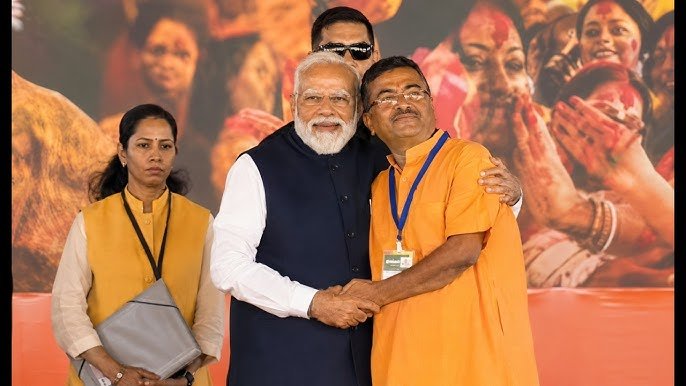
Kolkata: In a dramatic political shift that has rewritten the history of West Bengal politics, the Bharatiya Janata Party has formed its first-ever government in the state, ending decades of dominance by regional parties. The oath-taking ceremony of the new Chief Minister marked a landmark moment not only for Bengal but also for national politics.

Thousands of supporters gathered across Kolkata as the newly elected Chief Minister took the oath of office in the presence of senior BJP leaders, party workers, and invited dignitaries. Celebrations erupted throughout the state, with party supporters calling it a “new dawn for Bengal.”
Political analysts believe the BJP’s victory was not sudden, but the result of a long-term electoral strategy carefully built over several years. The party focused heavily on grassroots expansion, booth-level organization, and aggressive outreach in rural and urban constituencies alike.
A major factor repeatedly highlighted during the campaign was the influence of Narendra Modi. Political observers described the election as significantly shaped by the “Modi factor,” with the Prime Minister’s rallies drawing massive crowds across Bengal. His speeches centered on development, infrastructure, investment, welfare schemes, and promises of faster economic growth for the state.
The BJP leadership projected the election as an opportunity to align Bengal with the central government’s development agenda. Supporters claimed that welfare initiatives launched under the leadership of Shri Narendra Modi had already created a strong connection with beneficiaries across rural and urban Bengal. Central schemes related to housing, sanitation, healthcare, and financial inclusion became a key part of the BJP’s campaign narrative.
Another important aspect of the “Modi effect” was the consolidation of first-time voters and youth support. The BJP’s campaign machinery emphasized strong leadership, national security, and economic transformation, themes that resonated strongly among younger voters and sections of the middle class.
One of the biggest factors behind the BJP’s success was its ability to convert anti-incumbency sentiment into a statewide movement. The party campaigned on issues such as unemployment, industrial development, corruption allegations, political violence, and infrastructure improvement. Extensive social media campaigns and direct voter engagement also helped the BJP connect with voters across regions.
The BJP leadership strategically strengthened its organizational structure in Bengal by inducting influential local leaders and expanding its presence in districts where it previously had limited support. Analysts also point to the party’s emphasis on welfare delivery, women voters, and nationalist messaging as major contributors to the breakthrough victory.
The oath ceremony itself symbolized a major transition in Bengal’s political landscape. Senior BJP leaders described the victory as “historic” and promised a government focused on development, investment, employment generation, and law-and-order reforms.
Meanwhile, opposition parties acknowledged the scale of the political upset while vowing to play the role of a strong opposition. Political observers say the defeat of long-standing regional dominance will trigger deep introspection among rival parties in the state.
Citizens across Bengal are now watching closely to see whether the new government can translate its campaign promises into governance. With high expectations and national attention focused on the state, the BJP government begins its tenure under immense political pressure and historic public scrutiny.
The victory is already being viewed as one of the most significant electoral turning points in modern Bengal politics, marking the beginning of a potentially new political era in the state.